Aarke Sparkling Water Maker: Which Model to Buy
Pick the Aarke Carbonator 3 if you want the best all-round Aarke sparkling water maker for most kitchens. Its 800 ml PET bottle, compact footprint and damper-controlled lever make it the easiest model to live with day to day. Choose the Carbonator Pro only if you want its glass bottle and one-handed Push-to-Lock operation.
On this page (9 sections)
- Which Aarke sparkling water maker is best for most kitchens?
- Carbonator 3 vs Carbonator Pro: what actually differs?
- What do you give up with the Carbonator Pro?
- When should you choose the Carbonator Pro instead?
- When does the Breville InFizz Fusion make more sense?
- How much sparkling water does an Aarke make per cylinder?
- Which Aarke model fits your kitchen counter?
- What should you check before buying an Aarke sparkling water maker?
- Our verdict: which Aarke sparkling water maker should you buy?
The Aarke sparkling water maker you should buy is the Carbonator 3 for most kitchens. It pairs an 800 ml BPA-free PET bottle with a damper-controlled lever in a compact stainless steel cabinet.
The Carbonator Pro is the step up for buyers who want a glass bottle and one-handed Push-to-Lock operation. The Breville InFizz Fusion is the model to consider if you want to carbonate juice, tea or cocktails, not just water.
This guide explains how the two Aarke models differ and where each one fits. If you are still deciding between the Swedish brand and the mass-market name, our Aarke vs SodaStream comparison covers that choice in detail.
Which Aarke sparkling water maker is best for most kitchens?
The Carbonator 3 is the best Aarke sparkling water maker for most homes because it balances the brand's design with the smallest footprint and the widest bottle capacity. Its stainless steel enclosure and damper-controlled lever give you the same manual, electricity-free carbonation as the Pro in a smaller cabinet.
That matters in a kitchen where counter space is already tight. The Carbonator 3 measures 6.02 in wide and 16.3 in tall, so it can sit beside a coffee maker or kettle without crowding the worktop.
Aarke builds both carbonators around the same core idea: a manual lever or shield pushes CO2 into a bottle of chilled water. Neither model needs electricity or batteries, so you can move one around the kitchen as your routine changes.
The Carbonator 3 also comes in several premium finishes. That makes it easier to match the machine to your other appliances rather than settling for one color.
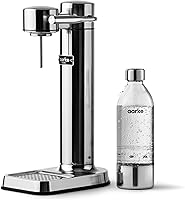
The stainless steel model shown here is the base Carbonator 3 package, which includes the carbonator, a manual and the 800 ml PET bottle. Aarke lists several Carbonator 3 variants under the same model line, including a version with CO2 and a version with a To-Go bottle.
What changes is what comes in the box.
For most readers, the Carbonator 3 is the model to buy first. Move up to the Pro only when a specific feature on it solves a problem the Carbonator 3 does not.
Carbonator 3 vs Carbonator Pro: what actually differs?
The two Aarke models differ in three main areas: bottle material and size, operating method and cabinet footprint. The Carbonator 3 is the smaller and lighter machine with the larger PET bottle.
The Pro is the larger, heavier machine with a glass bottle and a one-handed shield.
| Feature | Aarke Carbonator 3 | Aarke Carbonator Pro |
|---|---|---|
| Bottle | 800 ml BPA-free PET | 700 ml dishwasher-safe glass |
| Operation | Damper-controlled lever | Push-to-Lock with soft-close shield |
| Cabinet size | 10.16 x 6.02 x 16.3 in | 11 x 6.7 x 20 in |
| Weight | 1.72 kg | 6.3 kg |
| Power | Manual, cordless | Manual, cordless |
The Carbonator 3's 800 ml bottle holds more water per fill than the Pro's 700 ml glass bottle. That means fewer refills if you drink several glasses at once.
The Pro's glass bottle is dishwasher safe. If you prefer glass for taste or recycling reasons, the Pro is the model that offers it.
Aarke lists the Pro's glass bottle with a 700 ml marked filling line. That line is what you fill to, so 700 ml is the practical working volume.
The Pro also ships with more in the box than the Carbonator 3. Its included components list adds a cleaning cloth and an extra gasket alongside the glass bottle and instructions.
The Carbonator 3 base package includes the carbonator, manual and PET bottle.
What the Carbonator 3 lever gives you
The Carbonator 3 uses a damper-controlled lever. You pull it down to release CO2 into the bottle, and the damper smooths the motion so the lever does not snap back.
Aarke frames this as part of the ritual of making sparkling water. In practice, the lever is a manual control: you decide how long to hold it and how much fizz to add.
The slower motion also makes it easier to carbonate in small increments until you reach the level you like.
The 800 ml bottle is designed for durability and easy maintenance. It screws into the machine, and the lever system releases the carbonated water once you finish.
What the Carbonator Pro shield changes
The Carbonator Pro adds a protective shield with a soft-close mechanism over the bottle. You press down with one hand to lock the bottle in place and carbonate in a single motion.
That one-handed operation is the Pro's main practical advantage. If you often carbonate while doing something else with your other hand, the Push-to-Lock shield reduces the steps.
Aarke describes the shield as automatically securing the bottle and carbonating in one smooth motion.
The Pro's glass bottle also works with Aarke's stainless steel bottles, so you can add a metal bottle later if you want. Aarke says the Pro is compatible with its premium stainless steel bottles.
What do you give up with the Carbonator Pro?
You give up counter space, lighter weight and bottle capacity when you choose the Pro. The Pro is noticeably bigger and heavier than the Carbonator 3, and its glass bottle holds less water.
The Pro measures 20 in tall against the Carbonator 3's 16.3 in. It also weighs 6.3 kg against 1.72 kg, so it is a machine you place and leave rather than move around.
That weight gap is large enough to notice when you lift either one out of the box.
The glass bottle adds a handling consideration. Glass is dishwasher safe, but it is also heavier than PET and needs more care when you fill and seat it.
You also want to check it for chips over time, which is not something you worry about with the PET bottle.
The Pro's larger footprint matters if your counter is short. Measure the spot before you buy, because a 20 in tall machine can crowd the space under upper cabinets.
The Pro is also wider and deeper, so it needs clearance on all sides for the shield to open and close.
The Pro's price tier sits above the Carbonator 3 in Aarke's lineup, and the extra cost buys the glass bottle, the shield and the one-handed operation. None of this makes the Pro a bad machine.
It makes it a machine for a buyer who values glass and one-handed operation more than compact size. If those two features do not matter to you, the Carbonator 3 is the simpler buy.
When should you choose the Carbonator Pro instead?
Choose the Carbonator Pro if you want a glass bottle and one-handed carbonation and you have the counter space for a larger machine. It is the model for buyers who treat sparkling water as a daily ritual and want the most refined Aarke experience.
The glass bottle is the clearest reason. If you dislike plastic in contact with your drinking water, the Pro is the Aarke that avoids it.
The dishwasher-safe glass bottle also makes cleanup simple.
The Push-to-Lock shield is the second reason. Carbonating with one hand is handy when you are also holding a glass or stirring something on the stove.
The soft-close shield also covers the carbonation area, which keeps splashes contained. That is a small but real benefit in a busy kitchen.
Skip the Pro if your priority is a small footprint or the largest bottle per fill. The Carbonator 3 wins on both.
The Pro is the niche pick, not the default.
If you are comparing the Aarke lineup against other premium machines, our premium sparkling water maker roundup puts the Pro and its rivals side by side.
When does the Breville InFizz Fusion make more sense?
The Breville InFizz Fusion makes more sense if you want to carbonate drinks other than water. Its FusionCap lets you fizz juice, tea, cocktails and wine, and re-fizz flat soda.
Neither Aarke model is built for that.
If your household drinks plain sparkling water and little else, an Aarke is the cleaner choice. The Aarke lever and shield are simple, and the machines are compact and cordless.
But if you like flavored fizz, the Breville opens options the Aarke cannot match. You start with the full-flavor drink and then carbonate it, so the flavor stays in the bottle.
The Breville includes a 1 L bottle with a stainless steel cap and base, plus a cleaning brush, funnel and sieve. That 1 L capacity is larger than either Aarke bottle, which suits households that go through a lot of fizzy drinks.
You can store the bottle in the fridge for later.
The Breville also has a magnetic stainless steel drip tray, which catches spills and lifts out for cleaning. The Aarke models do not include a drip tray.
Breville's FusionCap also gives you a carbonation speed choice. You can run it fast or slow depending on the drink type, which helps with drinks that foam or react differently from plain water.
The Breville is a manual machine too, and it uses standard screw-type 60 L CO2 canisters. It ships without a cylinder, so budget for one.
Its locking system uses an ergonomic ring pull, which is a different motion from the Aarke lever.
If you mostly want plain water and prefer the Swedish design, stay with Aarke. For mixed drinks and flavored fizz, the Breville is the more useful tool.
Our carbonated water maker buying guide explains how to weigh these priorities.
How much sparkling water does an Aarke make per cylinder?
Aarke says each CO2 cylinder produces up to 2,000 ounces of carbonated water, which is roughly 167 standard 12 oz cans. That figure applies to both the Carbonator 3 and the Pro.
The actual yield depends on how much fizz you add to each bottle. A light fizz uses less gas per bottle than a heavy one, so a household that likes aggressive carbonation will refill the cylinder sooner.
Water temperature also affects how well the gas dissolves. Cold water holds carbonation better, so chill your water in the fridge before carbonating.
That helps you get more fizz from each press and less gas wasted on warm water.
The bottle size affects how many bottles you get per cylinder, not the total ounces. An 800 ml bottle on the Carbonator 3 holds more water per fill than the 700 ml glass bottle on the Pro.
With the same carbonation level, the Carbonator 3 needs fewer lever pulls to process the same total amount of water.
If you carbonate several bottles a day, keep a spare cylinder on hand. Swapping a cylinder is a screw-in job on both Aarke models, and the machine keeps working without power.
Aarke lists cylinder installation as an easy screw-in step, so a swap takes seconds rather than tools.
For a wider look at machines and their cylinder costs, our best carbonated water makers roundup compares the options that use standard cylinders.
Which Aarke model fits your kitchen counter?
The Carbonator 3 fits more kitchens because it is smaller and lighter than the Pro. Its 6.02 in width and 16.3 in height suit a narrow strip of counter beside the sink or stove.
The Pro needs more room. At 6.7 in wide and 20 in tall, it can bump into upper cabinets or a low shelf.
Measure the height from the counter to the underside of anything above it before you order.
Both machines are cordless and manual, so you do not need an outlet nearby. That gives you freedom to place one wherever you have space, including a pantry shelf or a bar cart.
Neither one needs batteries either.
The Pro's weight is the other placement factor. At 6.3 kg, it is heavy enough that you will want a stable spot rather than a spot you move often.
The Carbonator 3 at 1.72 kg is easier to shift. The Pro's weight also helps it stay put when you press the shield down with one hand.
Think about where you will fill the bottle. A spot near the sink saves trips, and both machines work without power.
The Pro's larger shield needs a bit more clearance to open and close smoothly.
Pick the Carbonator 3 if your counter is tight. Pick the Pro if you have a dedicated spot with headroom and want the glass-bottle experience.
What should you check before buying an Aarke sparkling water maker?
Check the bundle name, the CO2 cylinder and the bottle material before you order. Aarke sells several packages, and the base carbonator-only option does not include a cylinder.
The model names matter here. Aarke lists variants such as Carbonator 3 with CO2 and Carbonator 3 with To-Go.
Each package includes different parts, so read the name carefully.
The Pro has its own bundles as well, including a version with CO2.
If you buy the carbonator-only version, plan to buy a standard screw-in 60 L CO2 cylinder. Aarke machines use standard cylinders, so you can source one locally or through a refill service.
Decide whether you want PET or glass. The Carbonator 3 uses an 800 ml BPA-free PET bottle, which is light and durable.
The Pro uses a 700 ml dishwasher-safe glass bottle. Aarke also sells separate glass bottles for the Pro if you want a spare.
If you want to take sparkling water with you, look at the To-Go variants. Aarke sells a To-Go bottle that works with its carbonators, so you can carbonate at home and carry the bottle out.
There is a Carbonator 3 To-Go Bottle sold on its own and a To-Go bottle made for the Pro.
Finally, think about counter height and cabinet clearance. A 20 in tall Pro needs more headroom than a 16.3 in Carbonator 3.
A quick measurement now saves a return later.
Our verdict: which Aarke sparkling water maker should you buy?
Buy the Aarke Carbonator 3 if you want the best all-round Aarke sparkling water maker. Its 800 ml PET bottle, compact footprint and damper-controlled lever make it the easiest model to fit into most kitchens.
Choose the Aarke Carbonator Pro if glass and one-handed Push-to-Lock operation matter more to you than size and bottle capacity. It is the premium-tier pick for a dedicated counter spot with headroom.
Choose the Breville InFizz Fusion if you want to carbonate juice, tea, cocktails or wine. Its FusionCap handles drinks that the Aarke models are not built for.
That is the decision rule. Most readers should start with the Carbonator 3 and only move up when a specific feature earns the extra space.
If you are still weighing brands, the Aarke vs SodaStream comparison helps you decide whether the Swedish design is worth it for you.
Frequently asked questions
What is the difference between the Carbonator 3 and the Carbonator Pro?
The Carbonator 3 uses an 800 ml PET bottle and a damper-controlled lever in a compact 16.3 in tall cabinet. The Carbonator Pro uses a 700 ml dishwasher-safe glass bottle, a protective shield with soft-close, and Push-to-Lock operation, and it has a larger, heavier footprint.
Can an Aarke carbonator flavor juice or tea?
Aarke designs its carbonators for plain water. For juice, tea, cocktails and wine, the Breville InFizz Fusion uses its FusionCap to carbonate drinks other than water.
Pick that model if flavored fizz is your main goal, and keep an Aarke for plain sparkling water.
Does an Aarke sparkling water maker need electricity?
No. Both Aarke models are cordless and manual, so they need no power outlet or batteries.
You install a screw-in CO2 cylinder and press the lever or the Push-to-Lock shield.
How much sparkling water does one CO2 cylinder make?
Aarke says each cylinder produces up to 2,000 ounces, which works out to roughly 167 standard 12 oz cans. How close you get depends on how cold the water is and how much fizz you pump into each bottle.
Cold water holds carbonation better, so chill it before carbonating.
Do Aarke carbonators include a CO2 cylinder?
Some Aarke bundles include a cylinder and some do not, and the model names differ by package. Check the exact bundle name before you order, because the base carbonator-only option leaves you to buy a standard 60 L cylinder separately.
The Breville InFizz Fusion also ships without a cylinder.